
Law & Policy

DoD Instruction 4715.13: DoD Noise Program

DoD Instruction 3030.03, Joint Land Use Study (JLUS) Program

AFM 19-10/TM 5-803-2/NAVFAC P-970, Planning in the Noise Environment

AR 200-1, Environmental Protection and Enhancement

OPNAVINST 11010.40, Encroachment Management Program

OPNAVINST 3550.1A/MCO 3550.11, Range Air Installations Compatible Use Zones (RAICUZ) (canceled by MCO 3550.13)

MCO 11011.23, Marine Corps Encroachment Management Program

AFI 90-2001, Encroachment Management
Interim Guidance on Noise-Induced Sleep Awakening Analysis
Technical Bulletins
An Overview of Blast Noise: Characteristics, Assessment and Mitigation
Noise from large weapons (Artillery, tank) and explosives can travel long distances and still be loud enough to cause negative community reactions. A broad understanding of the characteristics, assessment methods, and noise management and mitigation strategies for blast noise will enable better planning and community communication/outreach to minimize training restrictions due to noise issues.
Community Annoyance Caused By Noise From Military Aircraft Operations
Long term community annoyance from aircraft noise is typically the greatest adverse effect of low altitude, subsonic overflights of residential populations. Understanding annoyance is essential to successful public relations in the vicinity of air installations and operating areas, and to informed decisions on changes to the military operations.
Effects of Aircraft Overflights on Domestic Fowl
This Technical Bulletin provides an overview of the existing literature on the effect of noise on domestic fowl, with particular emphasis on those studies that have focused on the observations of the behavioral effects produced by jet aircraft and sonic booms.
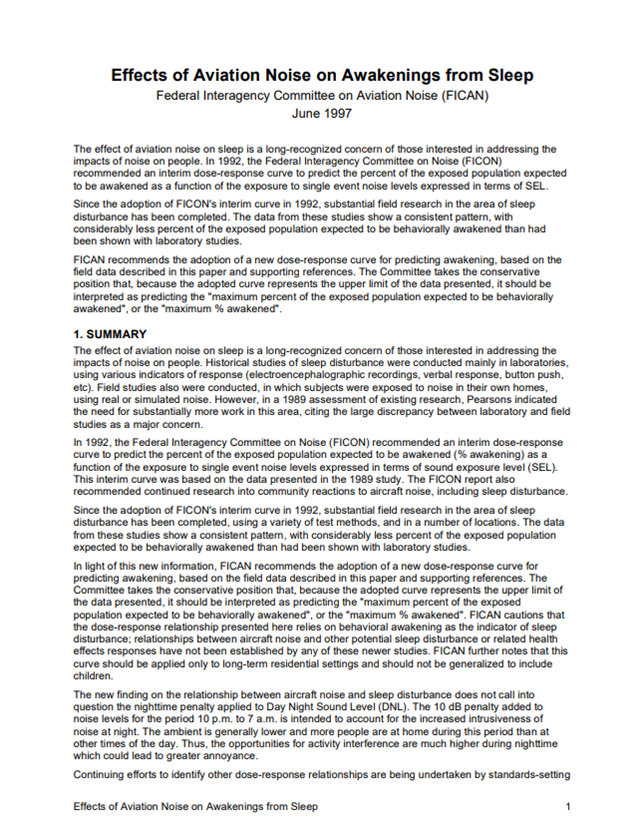
Effects of Aviation Noise on Awakenings from Sleep – Federal Interagency Committee on Aviation Noise (FICAN)
Improving Aviation Noise Planning, Analysis and Public Communication with Supplemental Metrics
The intent of this guidelines document is to guide the Military Services in providing useful information on the noise environment. There are two primary reasons for use of supplemental analysis tools and noise metrics: (1) to produce more detailed noise exposure information for the decision process; and (2) to improve communication with the public about noise exposure from military activities.
Noise-Induced Hearing Impairment
This Technical Bulletin provides a brief overview of hearing loss caused by noise exposure. The goal is to provide a sense of perspective as to how aircraft noise (as experienced on the ground) compares to other activities that are often linked with hearing loss.
Non-Auditory Health Effects of Aircraft Noise
This Technical Bulletin offers advice on how to address public concerns about non-auditory health effects due to exposure from military aircraft in residential areas. The intent is to help program officials discuss what is known about health effects when the issue comes up through public inquiries or as part of the environmental analysis process.
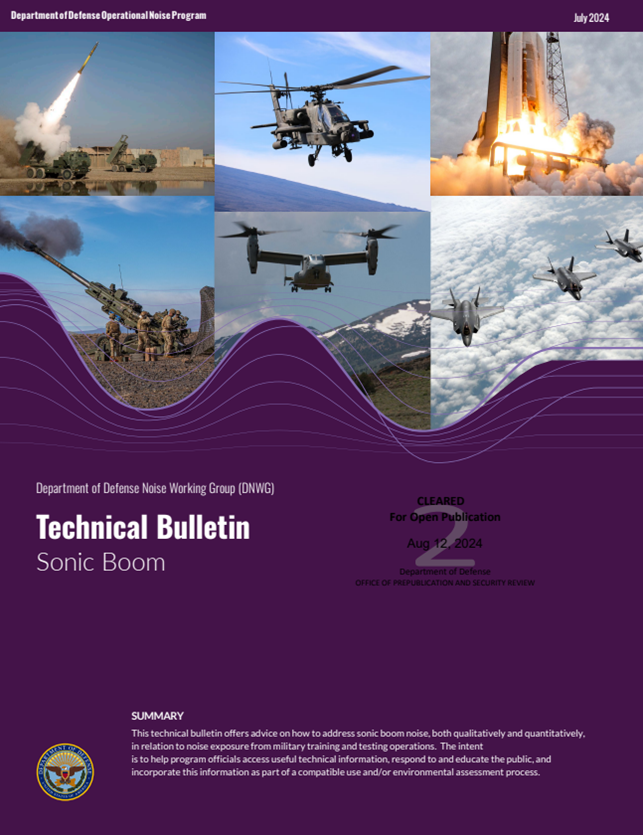
Sonic Boom
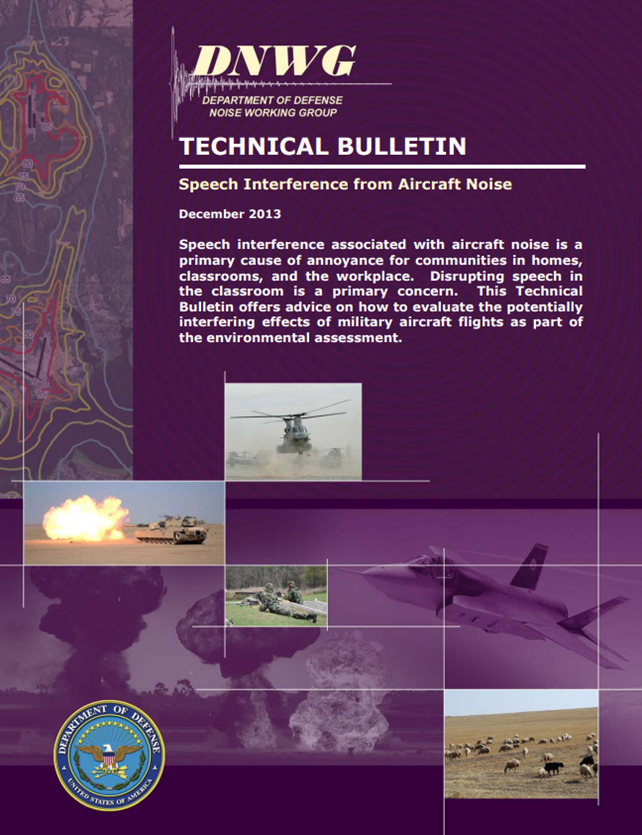
Speech Interference from Aircraft Noise
This Technical Bulletin offers advice on how to evaluate the potentially interfering effects of military aircraft flights as part of any environmental analysis.
Using Supplemental Noise Metrics and Analysis Tools
Supplemental noise metrics and analysis tools are used to produce more detailed noise exposure information for the decision process and to improve communication with the public about noise exposure from military activities.
Tools

The Military and You: Communities in Harmony

NOISEMAP
NOISEMAP is a suite of computer programs that work in concert to predict the noise exposure from aircraft flight, maintenance, and ground runup operations
Additional Guidance