
The Recovered Chemical Warfare Materiel (RCWM) Program uses a variety of proven technologies to assess munitions and certain materials of interest, and to then destroy those determined to be RCWM in a safe and efficient manner. The RCWM Program also has technologies for the destruction of Chemical Agent Identification Sets (CAIS) in a safe and efficient manner.
Additional needs and improvements to existing technologies are identified as requiring research, development, test and evaluation (RDT&E) through the RCWM Program support to explosives or munitions emergency responses involving RCWM and munitions responses at chemical warfare materiel (CWM) sites.
RDT&E on New Technologies
The RCWM Program continues working with government, academic, and industry scientists to improve the technology used during assessment of munitions and certain materials of interest and destruction of RCWM. The RCWM Program RDT&E effort involves a variety of partners, including Sandia National Laboratories, Idaho National Laboratory, the U.S. Army Combat Capabilities Development Command, and contractors.
Collectively, the RCWM Program RDT&E team:
- Researches alternative destruction technologies and secondary waste treatment methods by partnering with industry;
- Researches enhanced vapor monitoring, multi-agent chemical monitoring, decontamination methods, and destruction alternatives;
- Improves its explosive destruction and other systems, including the design, study and testing efforts for new systems capable of high-throughput RCWM destruction;
- Studies new means for the high-throughput systems to decontaminate debris, environmental media, and residual metals; and
- Enhances the Portable Isotopic Neutron Spectroscopy and Digital Radiography and Computed Tomography systems to provide improved assessment capabilities.
Planned Product Improvement
A critical part of the RCWM Program technology effort is planned improvements of existing equipment. Each system has, as a functional requirement, a routine examination of ideas to improve operational efficiency and effectiveness, environmental compliance, sustainability, and safety. These examinations draw on the gamut of sources and expertise from the theoretical understanding of the research scientist to the “hands-on” experience of the day-to-day system operators.
Proven Storage Technologies
Multiple Round Container
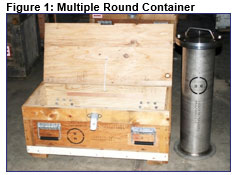
Once recovered, munitions and certain materials of interest or RCWM are placed in a Multiple Round Container (MRC), a sealed stainless steel, over-pack that provides safe storage and transport of RCWM. MRCs prevent chemical agent leaks, aiding in the protection of the public and workers during accidents or rough handling.
MRCs are specifically designed, tested, and fielded for the transport of RCWM and exceed international packaging requirements. The effectiveness is such that both the DoW and Department of Transportation approved MRCs for the storage and transportation of RCWM in the public domain.
Fact Sheet: Multiple Round Container. 2024.
Transportable Interim Holding Facility
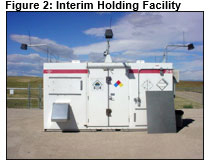
A Transportable Interim Holding Facility (IHF) provides safe, secure temporary storage for RCWM at sites where storage facilities, such as earth-covered magazines, and bunkers, are unavailable.
Construction consists of fireproof and corrosion-resistant materials. The transportable IHF includes a secondary containment area below the floor to contain liquids. The transportable IHF includes several high-security features and is enclosed in a fenced area when sited. Additionally, agent monitoring of the transportable IHF is conducted until the recovered items are removed for destruction. The transportable IHF design also allows for the installation of a chemical agent filtration system, if necessary.
Fact Sheet: Interim Holding Facility. 2021.
Proven Assessment Technologies
Over the last decade, the U.S. Army Chemical Materials Activity Recovered Chemical Materiel Directorate (CMA RCMD), developed a variety of non-intrusive, transportable technologies that can be brought to a known RCWM or munitions and certain materials of interest to help identify the contents. The mobility of these systems minimizes the need to transport the recovered items, reducing the risk to the public.
Today these systems are owned and managed by CMA RCMD and operated by CMA-trained personnel from the U.S. Army Chemical, Biological, Radiological, Nuclear, and Explosives (CBRNE) Analytical and Remediation Activity (CARA).
Mobile Munitions Assessment System
Unexploded ordnance, discarded military munitions, or munitions and certain materials of interest are encountered at CWM sites and test ranges. Although the size and shape of a munition provides an indication of possible fill, a munition type may contain one of several fills. When recovered, the contents of these items may not be easily identifiable.
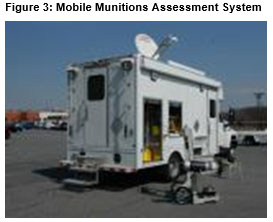
The Mobile Munitions Assessment System is a vehicle equipped with a variety of equipment and provides physical and chemical analysis of RCWM, and munitions and certain materials of interest with unknown fills. Mobile Munition Assessment System uses non-intrusive assessment equipment to provide detailed information on recovered items and distributes that information to appropriate authorities, reducing risk to the public, military, and emergency response personnel.
The RCWM Program has three Mobile Munition Assessment System units available for deployment to support explosives or munitions emergency responses or planned munitions responses.
The Mobile Munition Assessment System units and the equipment on board are owned and managed by CMA RCMD and operated by CARA.
Fact Sheet: Mobile Munitions Assessment System. 2024.
Digital Radiography and Computed Tomography System
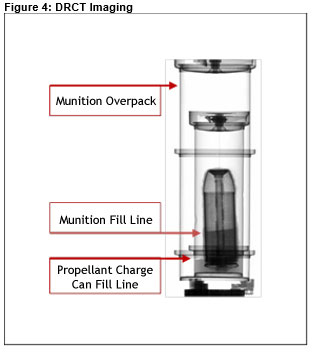
The field-portable Digital Radiography and Computed Tomography (DRCT) system allows response personnel to X-ray unidentified items on site. Operators use this information to make decisions regarding the safe handling and storage of recovered munitions and to assist in content identification.
The DRCT system scans each munition on a rotating platform, providing critical data even if the item is over-packed in a container.
Using image processing software similar to that used in the computerized tomography (CAT) scan, DRCT produces a digital view of the munition’s interior indicating whether the contents are solid or liquid and the presence of any explosive components. Response personnel then know whether the recovered item is a conventional munition or one with an unknown liquid fill requiring further assessment to determine if it is RCWM.
Fact Sheet: Digital Radiography and Computed Tomography System. 2024.
Portable Isotopic Neutron Spectroscopy
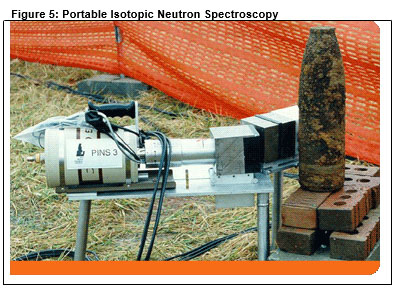
The Portable Isotopic Neutron Spectroscopy system identifies elements within closed munitions by using gamma rays, a form of naturally occurring radioactivity similar to X-rays.
Portable Isotopic Neutron Spectroscopy exposes the recovered item, often inside a container, to a focused gamma ray beam. Changes caused by the passage of the rays through the contents produce characteristic gamma-ray peaks, which help determine the presence and concentration of chemical elements. A team of analysts assess the results to determine if the item contains a fill such as a chemical agent, smoke or simulant.
Fact Sheet: Portable Isotopic Neutron Spectroscopy System. 2024.
Raman Spectrometer
Chemical Agent Identification Sets (CAIS) include glass ampoules, vials, and bottles that contain 4 ounces or less of chemical agents or industrial chemicals. The Army manufactured and distributed CAIS items to military installations around the country between 1928 and 1969.
Today the military services occasionally encounter old CAIS in storage or recover CAIS when performing excavations for construction or as part of planned munitions responses. Once recovered, identification of the container contents allows personnel to make the correct decisions as to the proper neutralent to use when treating the CAIS contents.
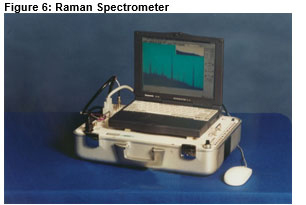
The Raman Spectrometer non-intrusively evaluates CAIS contents. The Raman Spectrometer, which fits inside a small carrying case, includes a:
- Portable computer for operating the system and analyzing collected data;
- Raman Spectrometer/laser; and
- Fiber-optic probe attached to a sample holder, which holds the materiel to be analyzed.
The operator evaluates the resulting output to determine which chemical agents or industrial chemicals are present, enabling environmentally safe destruction and disposal of the contents.
Fact Sheet: Raman Spectrometer. 2024.
Proven Destruction Technologies
Explosive Destruction System
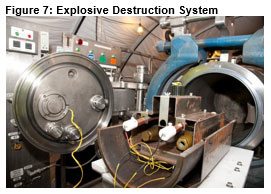
The Explosive Destruction System – EDS – provides on-site destruction of RCWM in a safe, environmentally sound manner. The EDS provides full containment of munitions while accessing and treating the contents and allows collection of samples to confirm destruction goals are met prior to opening the unit.
Designed by CMA RCMD and constructed by Sandia National Laboratories, the EDS serves as a transportable technology supporting munitions response, operational range clearance, and explosives and munitions emergency response operations. Sandia built multiple EDS units for RCMD, which retains the system’s patent.
The EDS uses linear shaped charges to explosively access the contents of RCWM, eliminating any explosive elements before the chemical fill is treated using a neutralizing chemical. The system’s main component, a sealed, stainless steel vessel, contains the blast, and fragments from the process. Once the chemical fill is neutralized, the EDS is drained and the residuals are sent to a permitted treatment, storage and disposal facility.
EDS units have processed more than 2,300 items since entering service in 1999.
Fact Sheet: Explosive Destruction System Overview. 2024.
Transportable Detonation Chamber
The Transportable Detonation Chamber (TDC) is a true explosive destruction system, as it uses the heat and pressure generated by an explosion to destroy the chemical fill of RCWM. The system has demonstrated the ability to destroy mustard, phosgene, chloropicrin, white phosphorus, smoke, and vomiting agents.
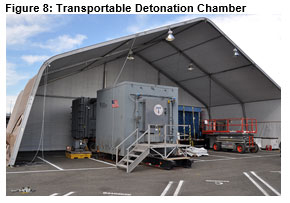
These systems have a DoD Explosives Safety Board net explosive weight rating of up to 60 pounds trinitrotoluene (TNT)-equivalent.
The TDC-60 has three main components: a detonation chamber, an expansion chamber, and an emissions control system. The personnel operating the TDC place a munition wrapped in explosives in the detonation chamber. The chamber contains material (e.g., pea gravel) to help absorb some of the blast energy. Bags containing water help absorb blast energy and produce steam, which reacts with chemical agent. Operators also add supplemental oxygen when destroying mustard agent. After the detonation, the resulting gases are vented to an expansion chamber, then to the emissions control system. The emissions control system includes a reactive-bed ceramic filter to remove acidic gases and to collect particulates such as soot and dust from the pea gravel. A catalytic oxidation unit oxidizes hydrogen, carbon monoxide, and organic vapors from the gas stream before venting the stream through a carbon adsorption bed and into the atmosphere.
In 2008, the TDC-60 unit successfully destroyed 71 munitions at the Schofield Barracks, HI.
In 2009-2010, the TDC-60 destroyed 282 pounds of mustard agent in 29 cylinders at Aberdeen Proving Ground, MD, during testing.
In 2010-2011, the system was deployed to Columboola, Queensland, Australia, where it treated 144 mustard-filled munitions.
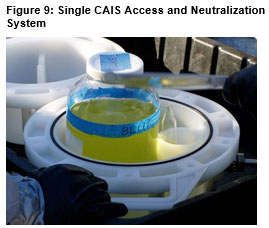
Single CAIS Access and Neutralization System
The Single CAIS Access and Neutralization System SCANS is a hand-held container used to access and destroy CAIS items containing the chemical agents mustard or lewisite. SCANS performed its first destruction of a CAIS item at Fort McClellan, AL in 2003.
The Army expects to continue to recover CAIS items on an occasional basis through ongoing remediation and construction activities. The volume of the SCANS container is approximately one gallon, enabling destruction of small quantities of recovered CAIS items.
Fact Sheet: Single CAIS Access and Neutralization System. 2024.
Proven Residuals Management Technologies
One of the goals of the DoW effort to eliminate all forms of chemical munitions and agents has been ensuring the residuals left after destruction are able to be recycled (e.g., decontaminated metal) or are safely disposed of as solid and/or hazardous waste.