
Mission
The DoD Recovered Chemical Warfare Materiel (RCWM) Program is executed within the United States by the Secretary of the Army, on behalf of the Office of the Secretary of War, to:
- Respond to explosive and munitions emergencies involving munitions and certain materials of interest that contain an unknown liquid or a chemical agent fill.
- Investigate and, as required, conduct munition responses at chemical warfare materiel (CWM) sites in accordance with the Department of War (DoW) Explosives Safety Office (DWESO)-approved site plan.
- Investigate and, as required, conduct range clearance activities on operational ranges where munitions and certain materials of interest that contain an unknown liquid or a chemical agent fill are encountered.
- Non-intrusively assess recovered munitions and certain materials of interest that contain an unknown liquid or chemical agent fill and Chemical Agent Identification Sets (CAIS) to determine the most likely fill.
- Destroy, normally on site, RCWM using an approved technology or procedure.
Additionally, on a cost-reimbursable basis, the RCWM Program Support Functions are provided to other DoW Programs, and, subject to approval by the Under Secretary of War for Policy, support the Department of State, the Combatant Commands, other federal, state, and tribal government agencies and other nations.
Objectives
The RCWM Program objective is to achieve, through application of rigorous project management principles and efficient use of RCWM Program resources, a comprehensive, coordinated, effective, and protective enterprise-based approach to conduct response actions at CWM sites within the United States.
Scope
The RCWM Program addresses situations involving:
- Explosives or munitions emergencies involving CWM, munitions and certain materials of interest recovered within the United States;
- Munitions responses, specifically CWM responses, at munitions response sites with munitions and certain materials of interest, RCWM, or chemical agent-contaminated debris or environmental media that pose a chemical agent hazard (referred to as “CWM sites”) within the United States;
- Other activities (e.g., range clearance activities) within the United States where munitions and certain materials of interest RCWM, or chemical agent-contaminated debris or environmental media that pose a chemical agent hazard are known or suspected to be present or encountered during the execution of those activities; and
- CWM and munitions and certain materials of interest determined to contain toxic chemicals or precursors listed in the Chemical Weapons Convention as scheduled chemicals that are recovered within the United States.
Support Functions
The RCWM Program provides the RCWM Support Functions, including:
- Procurement and maintenance of mobile equipment and operational capabilities required for the assessment of munitions and certain materials of interest that contain an unknown liquid fill and the destruction of recovered RCWM.
- Sustainment of the personnel and equipment required for the assessment of munitions and certain materials of interest that contain an unknown liquid fill and the destruction of RCWM.
- Research, development, test, and evaluation of, and associated improvements to, current technologies and the evaluation of off-the-shelf technologies available to meet RCWM Program requirements.
- Support of explosives or munitions emergencies that involve munitions and certain materials of interest that contain an unknown liquid fill or CWM and chemical agent identification sets.
- Archival research of CWM sites.
Integration with the Military Munitions Response Program (MMRP)
In 2001, DoW established the Military Munitions Response Program as one of three program categories in the Defense Environmental Restoration Program. While DoW has been responding to properties that were known or suspected to contain unexploded ordnance, discarded military munitions, or munitions constituents for many years, DoW policy established the Military Munitions Response Program in September 2001 to improve its overall approach for protecting human health and the environment, attain a better understanding of response requirements, and gain better visibility of total potential costs.
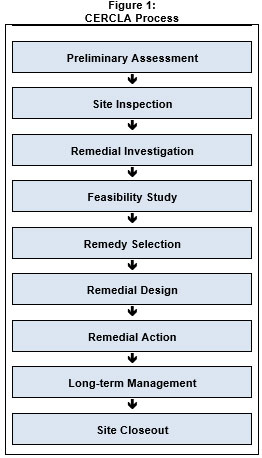
In executing munitions responses, DoW complies with applicable environmental laws and regulations laws, notably the (e.g., the Comprehensive Environmental Response, Compensation, and Liability Act (CERCLA), the National Oil and Hazardous Substances Pollution Contingency Plan (NCP)). Figure 1 illustrates the principal CERCLA phases. The DoW Military Munitions Response Program Website provides detailed information about the program.
Where munitions and certain materials of interest or RCWM are known or suspected to be present, the RCWM Program provides technical input during each phase of the response process; coordinates planned activities to support the efficient use of funding, equipment, and personnel; and executes assessment and destruction of RCWM during the Remedial Action phase. For example, during the:
- Feasibility Study, when there is a detailed analysis of various remedial alternatives to address site conditions, the RCWM Program provides information on the destruction process, the throughput of the destruction systems and the waste products produced.
- Remedial design phase, the RCWM Program provides information to assist the engineering team in the layout of the technology, and operational needs for support facilities, power, and water.
- Remedial action phase that the RCWM Program provides the greatest input, with the equipment, expert personnel, and funding to perform the actual assessment and destruction of the RCWM.
CWM Site Inventory
CWM sites include known or suspected burial and disposal areas, testing and training areas, or a combination of those areas where CWM (i.e., chemical munitions, bulk chemical agent, chemical agent residuals) or CAIS are known or suspected to be present. Sometimes, multiple types of CWM and conventional munitions are present at a CWM site.
DoW maintains an inventory of defense sites known or suspected to contain unexploded ordnance, discarded military munitions, or munitions constituents – including those sites where munitions and certain materials of interest or RCWM are known or suspected to be present. The DoW inventory, which is searchable by state, the District of Columbia, and the U.S. territories, is accessible online at http://www.denix.osd.mil/mmrp/mrsi/home/.
Funding
The RCWM Program activities are funded by the Defense-wide appropriation. This appropriation funds the RCWM Program Support Functions, which include:
- Procurement and maintenance of equipment and operational capabilities required for the assessment of munitions and certain materials of interest that contain an unknown liquid fill and the destruction of RCWM.
- Sustainment of the personnel and equipment required for the assessment of munitions and certain materials of interest that contain an unknown liquid fill and the destruction of RCWM.
- RDT&E of, and associated improvements to, current technologies and the evaluation of off-the-shelf technologies available to meet RCWM Program requirements.
- Support of explosives or munitions emergency responses that involve munitions and certain materials of interest that contain an unknown liquid fill or CWM and CAIS.
- Archival research of CWM sites.
Component Environmental Restoration Accounts (ERAs). Each Component has an ERA. These accounts are the sources of funding for environmental restoration activities unless otherwise directed by law. ERA funds the investigations, feasibility studies, selection of the remedy, all non-RCWM destruction and/or treatment operations, and post-remedial action monitoring.
Component Operations and Maintenance (O&M) Account. O&M funds include several separate appropriations (e.g., O&M, Army). Examples of costs financed by O&M funds are headquarters operations, expenses of operational military forces, training and education, and base operations support. In the context of the RCWM Program, O&M accounts support DoW’s initial response to explosives or munitions emergencies and fund operational range clearance activities that may require RCWM Program support.