
Introduction
The Recovered Chemical Warfare Materiel (RCWM) Program is comprised of a variety of organizations with distinct responsibilities during explosives or munitions emergency responses to address munitions and certain materials of interest, RCWM, or chemical agent (CA)-contaminated debris or environmental media that pose a chemical agent hazard. The RCWM Program also supports environmental responses to address munitions response sites and other locations known or suspected to contain munitions and certain materials of interest, RCWM, or chemical agent-contaminated debris or environmental media that pose a chemical agent hazard (referred to as CWM sites) within the United States.
Figure 1 RCWM Program Organization Structure
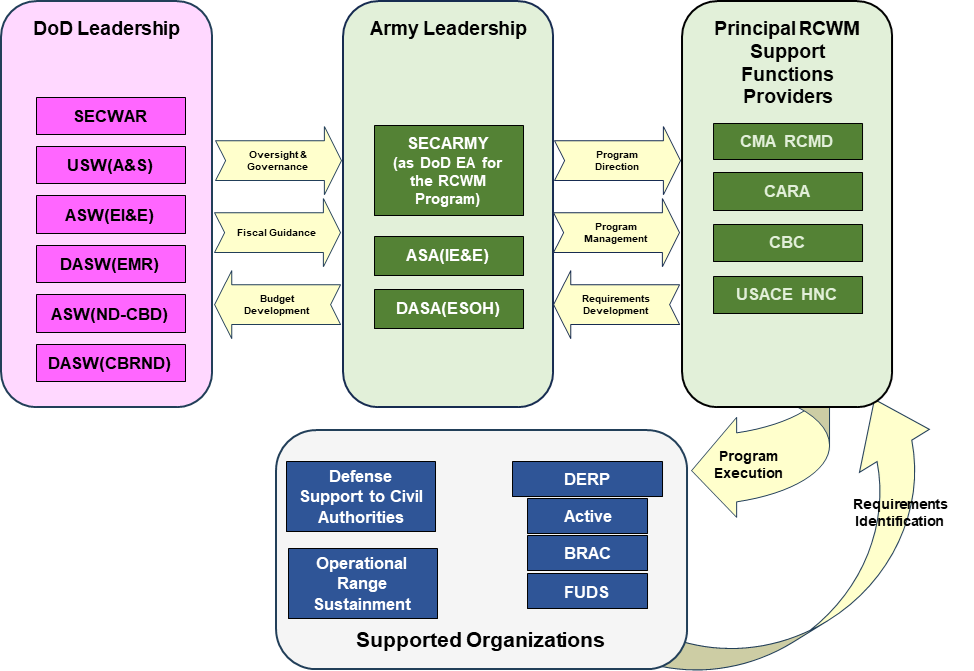
ASA(IE&E) = Assistant Secretary of the Army for Installations, Energy & Environment
ASW(EIE) = Assistant Secretary of War for Energy, Infrastructure, and Environment
ASW(ND-CBD) = Assistant Secretary of War for Nuclear Deterrence, Chemical, and Biological Defense, Policy and Programs
CARA = CBRNE Analytical and Remediation Activity
CMA RCMD= Chemical Materials Activity, Recovered Chemical Warfare Materiel Directorate
DASA(ESOH) = Deputy Assistant Secretary of the Army for Environment, Safety and Occupational Health
DASW(EMR) = Deputy Assistant Secretary of War for Environmental Management and Remediation
DASW(CBRND) = Deputy Assistant Secretary of War for CBRN Defense
EA = Executive Agent
FUDS = Formerly Used Defense Sites Program
SECARMY = Secretary of the Army
SECWAR = Secretary of War
USACE HNC = USACE Engineering Support Center, Huntsville
USW(A&S) = Under Secretary of War for Acquisition and Sustainment
Organizational Roles
Secretary of the Army
In May 2016, the Deputy Secretary of Defense issued DoD Directive 5101.17E, Roles and Responsibilities Associated with the Recovery of Chemical Warfare Material, dated 11 May 2016, Change 3 effective 9 May 2022, assigning the Secretary of the Army as DoW’s Executive Agent (EA) for the RCWM Program within the United States.
Assistant Secretary of the Army for Installations, Energy, & Environment (ASA(IE&E))
The Secretary of the Army further delegated the DoW EA for the RCWM Program responsibilities within the United States to the ASA(IE&E) via a 17 February 2021 memorandum.
Deputy Assistant Secretary of the Army for Environment, Safety, and Occupational Health (DASA (ESOH))
The DASA(ESOH) performs the day-to-day RCWM Program oversight on behalf of the ASA(IE&E). As such, DASA(ESOH):
- Provides senior leadership, policy, guidance, and centralized oversight of the RCWM Program;
- Ensures cross-functional coordination with senior leadership in the Army, other Components, the RCWM Program Execution Manager and, as appropriate, external stakeholders;
- Ensures the cost-effective and efficient use of RCWM Program resources;
- Ensures maintenance of an inventory of sites known or suspected to contain munitions and certain materials of interest or RCWM), and other locations of potential interest to the RCWM Program;
- Approves the RCWM Program Annual Work Plan in coordination with the Components’ Environmental Program Managers and RCWM Program Execution Organizations;
- Approves identified requirements for RCWM Program RDT&E efforts; and
- Provides, through the Headquarters of the Department of the Army and the appropriate chain of command, oversight of the Chemical Materials Activity Center for Treaty Implementation and Compliance activities to ensure compliance with the Chemical Weapons Convention.
U.S. Army Chemical Materials Activity (CMA)
The Army’s assessment and destruction program execution management functions specific to munitions and certain materials of interest and RCWM are consolidated into a single organization: CMA. CMA was established to manage the chemical weapons stockpiles, assess and destroy RCWM, and managed the Chemical Stockpile Emergency Preparedness Program in the communities around the stockpile sites. CMA and DoW successfully destroyed the U.S. former chemical warfare production facilities, the binary chemical weapons inventory, and chemical weapon stockpiles at nine different sites around the Nation.
Today, CMA oversees:
- Safely assessing and transporting munitions and certain materials of interest;
- The safe destruction of RCWM using transportable technologies; and
- The Center for Treaty Implementation and Compliance efforts to ensure compliance with the Chemical Weapons Convention.
- CMA also provides the National Inventory Control Point for RCWM.
U.S. Army CMA Recovered Chemical Materiel Directorate (RCMD)
Within CMA, RCMD:
- Plans and manages execution of the assessment of munitions and certain materials of interest and the destruction of RCWM in support of explosives or munitions emergency responses, and other environmental responses;
- Coordinates, as required, with the DoW EA for the RCWM Program, the Component Environmental Restoration Program managers, and other RCWM Program Support Function providers;
- Convenes and co-chairs the Materiel Assessment Review Board (MARB), and maintains a database of information concerning MARB determinations whether munitions and certain materials of interest are RCWM and the associated recommendations for destruction/disposal;
- Acts as the single program wide execution authority (including assignment of duties to service providers) for life-cycle logistics support including:
- Spare parts and consumable item procurement and storage;
- Shipment of equipment and explosives to operational deployment locations;
- Warehouse management control of RCWM Program assets;
- Maintain property book accountability as hand receipt holder for RCWM Program items/assets;
- Coordinate, schedule, and track routine preventative and corrective maintenance on RCWM Program equipment;
- Develop and sustain maintenance documentation and operating procedures for EDS units;
- Maintain the drawing packages under configuration management for RCWM Program equipment;
- Manage the training program for operating RCWM Program equipment used in destruction operations;
- Prepares operational deployment documents (e.g., site safety plans, destruction plans, transportation plans, and environmental permitting documentation, After Action Reports, and through the Center for Treaty Implementation and Compliance, Chemical Weapons Convention Destruction Certifications)
- Develops programmatic cost estimates and supports budget submissions for provision of the RCWM Program Support Functions;
- Supports Chemical Weapons Convention treaty requirements analysis and related reporting;
- Works with Component organizations to identify technology gaps and develop RDT&E requirements; and
- Develops and manages product improvements to existing RCWM Program equipment.
RCWM Program Integrating Office (IO)
Within CMA, the RCWM Program IO:
- Works, on behalf of CMA, DASA(ESOH), RCMD, the RCWM Program Support Function providers, and the supported Components, as the day-to-day integrator of the RCWM Program;
- Assists DASA(ESOH), CMA, and RCMD, as directed, in formulating and disseminating budgets information, guidance, policies, resource allocations, and schedules to ensure RCWM Program Support Functions are available to meet requirements;
- Maintains the CWM Site Inventory of those locations within the United States that are known or suspected to contain munitions and certain materials of interest, RCWM, or chemical agent-contaminated debris or media posing a chemical agent hazard, including those CWM sites that have already reached the “response complete” milestone under the Defense Environmental Restoration Program and DoD Manual 4715.20;
- Drafts the Annual RCWM Program Work Plan; coordinates submissions, policies, reports and schedules, as appropriate, with the Components; assists in resolving comments; and provides recommendations for approval;
- Participates in the DoW planning, programming, budgeting and execution process to help ensure adequate funding required for the RCWM Program Support Functions is identified and requested;
- Monitors the impact on the RCWM Program of external requirements (e.g., support of Combatant Commands, the Department of State) for supply of the RCWM Program Support Functions;
- Assists the DoW EA for the RCWM Program, other RCWM Program organizations, and the Components in communications with external stakeholders (e.g., federal, state and tribal regulatory agencies, the public);
- Serves as a subject matter expert for the RWCM Program; and
- Facilitates and documents RCWM Program stakeholder review sessions to examine performance against established metrics, evaluates and recommends potential solutions to resolve concerns, and documents achievements.
U.S. Army Corps of Engineers (USACE)
At the Headquarters level, the U.S. Army Corps of Engineers (USACE) provides overall coordination and quality management of all programmatic activities, development of USACE technical and safety guidance, and designation of National Program Managers.
The USACE is also the lead for the DoW Formerly Used Defense Sites (FUDS) Program. Those responsibilities include the conduct of munitions responses involving munitions and certain materials of interest, RCWM, or CA-contaminated debris or media posing a CA hazard. In this way, USACE is both a supporting and supported organization.
As discussed below, other USACE organizations execute certain mission responsibilities for the RCWM Program on behalf of the DoW EA for the RCWM Program and the DoW Components.
Engineering Support Center, Huntsville (USACE HNC)
The USACE HNC supports specialized missions that require expertise in execution of programs that are national or broad in scope. The Center supports tasks not normally accomplished by a Headquarters USACE element; tasks that require a centralized management structure, integrated facilities, or systems that cross geographic division boundaries; and tasks that require commonality, standardization, multiple-site adaption, or technology transfers. Within the USACE HNC are the Ordnance and Explosives Directorate and the Chemical Warfare Materiel Design Center (CWMDC).
Ordnance and Explosives Directorate
The Ordnance and Explosives Directorate is the execution arm for the environmental work executed at USACE HNC. The Directorate’s divisions supporting the RCWM Program include the Military Munitions Design Center and the CWMDC. With respect to the RCWM Program, the Ordnance and Explosives Directorate capabilities include:
- Planning and executing removal or remedial responses under DERP, the Comprehensive Environmental Response, Compensation, and Liability Act (CERCLA), or the Resource Conservation and Recovery Act (RCRA), addressing munitions and certain materials of interest, RCWM, and/or chemical agent-contaminated debris or media posing a chemical agent hazard;
- Providing security, logistics, and operational support to chemical and/or conventional munitions and explosives of concern removal or remedial responses; and
- Contracting support (e.g., development of Scopes of Work/Performance Work Statements, review of vendor proposals; oversight of contract execution).
Chemical Warfare Materiel Design Center (CWMDC)
The CWMDC executes projects involving munitions and certain materials of interest, RCWM, or chemical agent-contaminated debris or media posing a chemical agent hazard per applicable regulations and policies.
The CWMDC is the only USACE Design Center authorized to execute such response actions.
The CWMDC’s highly trained Chemical and Explosives Safety Specialists:
- Provide technical expertise and oversight to the planning and execution of all phases of RCWM Program recovery;
- Participate in preparation of Scopes of Work/Performance Work Statements and review of vendor proposals to ensure that technical requirements are addressed;
- Coordinate reviews of contractor submittals for compliance with contract requirements (e.g., compliance with environmental and explosives safety requirements; contractor deliverables have required certifying statements and/or quality control signatures);
- Coordinate periodic inspections of contractor compliance with the approved work plan, conduct or support other surveillance activities, support all on-site quality assurance activities, and develop the final Quality Assurance Report;
- Conduct reviews of environmental sampling and chemical analysis data; and
- Review laboratory accreditation for each of the laboratories/methods used to ensure compliance with contract and Quality Assurance Program Plan/Sample Analysis Plan.
20th Chemical, Biological, Radiological, Nuclear, and Explosives (CBRNE) Command
The 20th CBRNE Command has a full-time focus on combating weapons of mass destruction, countering CBRNE threats, and defeating improvised explosive devices.
The 20th CBRNE Command is 75% of the Active Army’s Explosives Ordnance Disposal units. Local Explosives Ordnance Disposal units across the Army, Navy, Marine Corps, and Air Force are the first responders to an explosives and munitions emergency involving military munitions.
In addition, Explosives Ordnance Disposal teams may be requested to support civil authority responses to explosives or munitions emergencies involving explosives or munitions that are not military munitions when such requests are made under DoD Directive 3025.18, Defense Support of Civil Authorities (DSCA), December 29, 2010, Incorporating Change 2, March 19, 2018.
CBRNE Analytical & Remediation Activity (CARA)
The CARA supports the RCWM Program on a reimbursable basis by providing technical expertise to support explosives or munitions emergency responses that involve munitions and certain materials of interest and supporting the provision of the RCWM Program Support Functions. CARA also co-chairs the MARB.
CARA’s munition assessment personnel are subject matter experts within the DoW for non-intrusive assessments of munitions and certain materials of interest.
CARA is comprised of two Remediation Response Sections– East (RRE) and West (RRW) – that simultaneously support Homeland Defense and Combatant Commanders. A Remediation Response Section is composed of two Remediation Response Teams which utilize the RCWM Program’s Mobile Munition Assessment System, a mobile analytical platform for non-intrusive analysis of munitions and certain materials of interest. In addition, CARA supports site assessments and remediation, including recovery, transportation, and destruction of RCWM.
Chemical Biological Center (CBC)
The CBC performs the following functions in support of the RCWM Program:
- Maintaining a qualified team of maintenance technicians to perform preventative and corrective maintenance on EDS units, Interim Holding Facilities (IHFs), and other systems and related support equipment necessary to the RCWM Program;
- In support of planning and preparation for testing and field operations, providing technical support in the areas of CA monitoring, environmental quality, filtration/ventilation, industrial hygiene, safety, sampling and analysis, and waste disposal;
- Managing and executing RDT&E funds allocated to support the RCWM Program validated material development requirements; and
- As needed, supporting field deployments by providing the following functions on a cost reimbursable basis:
- Setup, operate, and maintain EDS and supporting equipment;
- On-site analytical laboratory operations, CA monitoring, environmental compliance, and safety support;
- Provision of specialized equipment required to support operations, beyond the equipment managed by the RCWM Program;
- Waste characterization, management, storage, transportation, and disposal;
- Testing, certification, and operation of filtration/ventilation equipment; and
- In support of test and evaluation functions related to RCWM Program assets (e.g., upgrades to existing EDS, RDTE on new destruction systems), provides chemical agent synthesis and simulant management.
DEVCOM History Office
The DEVCOM History Office performs archival research in support of the RCWM Program. In this role, the History Office:
- Provides subject matter expertise related to the history of the U.S. chemical warfare program;
- Conducts or oversees archival research for the RCWM Program, as required;
- Acquires and preserves knowledge about the U.S. chemical warfare program by ensuring that documents, oral interviews, visual images, and other source materials pertaining to historically significant developments and events are placed in the historical research collection;
- Advances knowledge through research to provide historical perspective and support to decision-making, military problem-solving, and materiel research and development; and
- Disseminates the collected knowledge through printed, electronic, and multimedia formats that focus on historical themes and events.
DoD Component Defense Environmental Restoration Programs (DERP)
Each Component maintains an Environmental Restoration Program (ERP) under DERP. These programs implement the requirements under Title 10 United States Code (U.S.C.), Chapter 160—Environmental Restoration (sections 2700-2711) and the delegated Presidential authorities in sections 9601-9675 of the Comprehensive Environmental Response, Compensation and Liability Act (CERCLA) (42 U.S.C. 9601 et seq.).
The Components execute munitions responses per CERCLA and the National Contingency Plan. Most responses to address military munitions, including munitions and certain materials of interest, RCWM, or chemical agent-contaminated debris or media that pose a chemical agent hazard, fall under DoW’s Military Munitions Response Program within the DERP. The RCWM Program supports the DoW Services in meeting their ERP obligations though provision of the RCWM Program Support Functions.
DoD Manual 4715.20, Defense Environmental Restoration Program, March 9, 2012, Incorporating Change 1, August 31, 2018, provides additional information and DoW policies governing DERP.