
Demonstration Overview
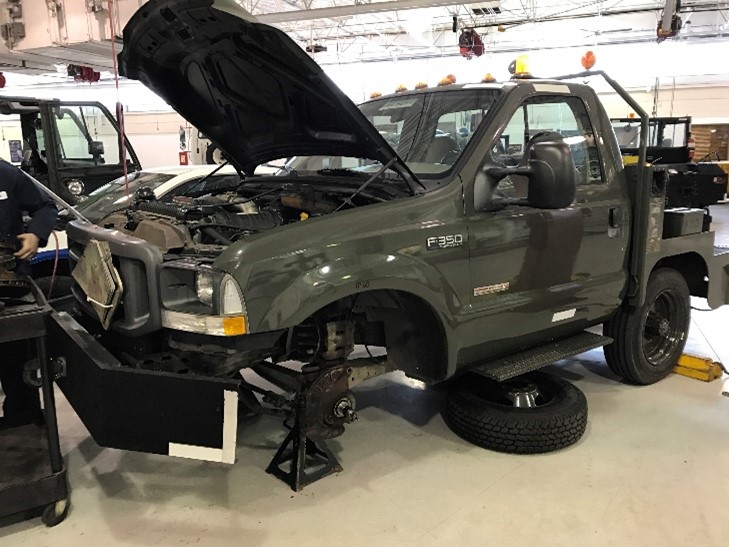 The DoW STED Program conducted test and evaluation (T&E) of biobased multipurpose lubricants for use in maintenance operations at Department of War (DoW) and federal facilities. Multipurpose lubricants are designed to lubricate and protect components, loosen rusty/frozen parts, and displace moisture in various conditions and industrial settings.
Multipurpose lubricants have been designated for Federal procurement preference by the United States Department of Agriculture (USDA) BioPreferred Program. The BioPreferred Program defines multipurpose lubricants as:
For more information regarding the biobased multipurpose lubricants demonstration, please Contact Us.


“Products designed to provide lubrication under a variety of conditions and in a variety of industrial settings to prevent friction or rust. Greases, which are lubricants composed of oils thickened to a semisolid or solid consistency using soaps, polymers or other solids, or other thickeners, are not included in this item. In addition, task-specific lubricants, such as chain and cable lubricants and gear lubricants, are not included in this item.”
The BioPreferred Program established a minimum biobased content of 88 percent for multipurpose lubricants.
Biobased options can offer improved lubricating efficiency, reduced hazards (e.g., higher flashpoint) and toxicity, and lower risk of environmental contamination from spills. Before these biobased products are utilized by the Military Departments and DoW Components, their performance must be proven to meet DoW requirements.
Demonstration Products
The following biobased products were tested and evaluated:
- Bio-Blast Penetrant by Renewable Lubricants, Inc
- Bio-Penetrating Lubricant (BPL) by Renewable Lubricants, Inc
- BPL + Moly + Tack by Renewable Lubricants, Inc
- Trick Shot Penetrating Lubricant by STAAR Lubricants LLC
- Fuel Ox Infinity Lube Super Spray by Fuel OX
- Gear Hugger ECO Multipurpose Lubricant by Gear Hugger
- 5 Star Penetrating Lubricant by 5 Star Superior Products
*Mention of or referral to commercial products, services, and manufacturers herein is provided for informational purposes only and does not constitute endorsement by, nor the official policy or position of, the Department of War (DoW), any of its Components, or the U.S. Government.
Demonstration Sites
Field T&E of these products was performed at the following DoW installations and co-located federal facilities to evaluate their performance in operational environments and to raise awareness of biobased product availability:
- MCB Quantico Weapon Training Battalion
- MCB Quantico Range Management
- Crane Army Ammunition Plant
- Shaw AFB
- Edwards AFB
- Quonset Point Air National Guard Station
- NASA Armstrong Flight Research Center
Demonstration Details
A biobased multipurpose lubricant demonstration plan was developed to outline the T&E activities to be performed, identify site performance requirements and the key performance criteria, as well as select the product to be evaluated. Installation personnel were provided a supply of the products for use in their operations and asked to provide feedback on the product performance. This demonstration commenced in March 2024 and concluded in March 2025. Table 1 contains the key performance criteria that the stakeholders established to evaluate and validate that the biobased brake cleaners met the participants’ requirements.
Table 1: T&E Performance Criteria
| Criteria | Parameters |
|---|---|
| Lubricating Performance |
|
| Ease of Application |
|
| User Safety/Friendliness |
|
T&E Results
The participating end user activities within the listed installations reported feedback on the biobased multipurpose lubricant product performance compared to their baseline multipurpose lubricants, which included many commonly used non-biobased multipurpose lubricants. Overall, the biobased multipurpose lubricants met the performance requirements of the demonstration facilities as follows:
- Lubricating Efficiency: In most applications, the demonstration products met or exceeded the lubricating efficiency requirement.
- Lubricant Adherence: In most applications, the demonstration products met or exceeded the lubricant adherence requirement.
- Quantity of Lubricant: In most applications, the same quantity of biobased product was used per application as the baseline product. This is likely because users transferred their expectation of quantity needed from use of their baseline products to use of the biobased alternatives. One site reported a 50% reduction in lubricant quantity required when using one of the demonstration products due to improved lubricating efficiency and lubricant adherence.
- Ease of Application: For all applications except one, the demonstration products met or exceeded the ease of application requirement. For the one application that did not meet the ease of applications requirements, the product was provided in bulk and a separate pressurized sprayer was used by the installation.
- Odor: For all sites except one, the demonstration products odor was satisfactory. The one site that reported odor as not satisfactory stated that two of the demonstration products smelled like used cooking oil.
- Eye Irritation: For all applications, no eye irritation was experienced with the biobased multipurpose lubricant.
- Respiratory Irritation: For all applications, no respiratory irritation was experienced with the biobased multipurpose lubricant.
- Skin Irritation: For all applications, no skin irritation was experienced with the biobased multipurpose lubricant.
Demonstration sites reported product performance, by application, as follows:
- Manufacturing Equipment (three products at one site):
- 2 products met all requirements
- 1 product did not meet all requirements (viscosity too thin)
- Chains, Cables, Pistons and Other Actuated Parts (five products at four sites):
- 4 products met or exceeded (better lubrication, easier to apply, better adherence, less used) all requirements
- 1 product did not meet all requirements at one site (viscosity too low and dried too fast, the same or less adherence)
- Gear Motor and Bearings for Moving Targets (three products at one site):
- No products met all requirements (two had reduced performance at low temperatures, two had less adherence, and two required the use of more product)
- Target Mover Wheels (one product at one site):
- The product met all requirements
- Cargo Loader Deck Rollers (one product at one site):
- The product met or exceeded (better lubrication and adherence) all requirements
- Facility Door Hinges, Hatches, and Windows (two products at two sites):
- 1 product met or exceeded (better adherence and less quantity needed) all requirements
- 1 product met all requirements
- Vehicle/Equipment Hinges and Door Handles (three products at one site):
- 2 products met all requirements
- 1 product did not meet all requirements (not as isolated of a spray pattern (ease of use); though it exceeded performance of baseline product in lubricating efficiency, lubricant adherence, and quantity of use)
- Penetrate Rust, Unfreeze Corroded Parts, Loosen Seized Bolts and Other Mechanical Parts (five products at three sites)
- 3 products met or exceeded (better lubrication and adherence, less quantity needed) all requirements
- 2 products did not meet all requirements (not as isolated of a spray pattern (ease of use); viscosity too low and dried too fast, the same or less adherence)
- Assist Install of New Parts (e.g., bolts and tight rubber/plastic parts) (two products at one site)
- Neither product met all requirements (one product quickly lost viscosity and became watery base when applied in bulk via pressurized sprayer or had too low a viscosity and dried too fast in aerosol form. The latter was also true of the other product when applied in bulk via sprayer. Both products had the same or less adherence (when applied in bulk via pressurized sprayer) or okay in some applications but didn’t last long enough in others and required reapplication (aerosol))
- Wheel Hubs (three products at two sites):
- 1 product met or exceeded (better lubrication, stopped hub from squeaking) all requirements
- 2 products did not meet all requirements (same feedback as above for Assist Install of New Parts)
The biobased multipurpose demonstration identified a few areas where the performance of the biobased multipurpose lubricants could be improved for use by DoW facilities. The DoW STED Program team communicated the demonstration feedback to the biobased multipurpose lubricant manufacturers to assist in addressing issues relating to the performance of the lubricants at the demonstration facilities.
In evaluating cost effectiveness, factors such as purchase price, lubricant usage rates, and disposal costs affect the overall lifecycle cost of multipurpose lubricants. As the demonstration sites primarily use aerosol multipurpose and penetrating lubricants, the cost analysis compared baseline aerosol lubricant products to aerosol and spray biobased lubricant products. Purchase prices for the baseline multipurpose lubricant products were determined from Defense Logistics Agency (DLA) FedMall at the time of the analysis. Both biobased and baseline multipurpose lubricant purchase prices varied widely.
- The average purchase price of the biobased multipurpose lubricants was 0.33% lower than that of the baseline multipurpose products, making their average prices practically identical.
- Most sites reported using the same amount of biobased lubricant per application as they did with the baseline products. This is likely because users’ familiarity with the quantity of baseline products required was transferred to the biobased alternatives. As a result, any changes in the usage of biobased products compared to the baseline could not be determined and could not be incorporated into the cost analysis.
- Multipurpose lubricants are regarded as total loss lubricants, as they are not recovered or recycled and are lost to the environment. It is difficult to assign an associated cost to waste disposal of the spent containers due to varying state and local requirements for disposal of spent aerosol and spray containers. As baseline and demonstration containers are very similar, any difference in waste disposal cost would be negligible.
The average purchase cost of the biobased multipurpose lubricants was approximately 0.33% less than the baseline multipurpose lubricants. According to feedback from the participating demonstration sites, the amount of biobased multipurpose lubricant used per application was generally the same as the baseline multipurpose lubricants, due to user habits. Therefore, in general, the cost of the biobased lubricants is comparable to that of the baseline products.
GSA Multiple Award Schedules
Some of the demonstration products are available on GSA multiple award schedules (search by manufacturer name). Some of the demonstration products are listed on GSA Advantage or FedMall.