
Demonstration Overview
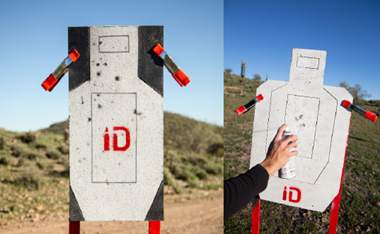 The DoW STED Program conducted test and evaluation (T&E) of reusable small arms targets made from recycled rubber at Department of War (DoW) Installations. These durable firearm targets are made from USA-sourced recycled rubber and can be used multiple times for thousands of rounds, in any weather, without fragmentation.
For more information regarding the reusable recycled rubber small arms targets demonstration, please Contact Us.


Traditional firearm targets utilize paper, cardboard, tape, and staples, which are consumed quickly and generate a recurring waste stream. The paper and cardboard may come from non-recycled supplies and thus contribute to natural resource depletion. Paper targets and backers require additional coating or cover with plastic sleeves to withstand precipitation in inclement weather. The demonstration targets, in contrast, are constructed of 100% recycled rubber and are far more durable, with a single target capable of handling up to 110 rounds of 5.56 millimeter (mm) ammunition per square inch. The material is non-ricochet and safe for close quarters while also allowing for expanded training environments in any weather. Target strikes are visible and require only touch-up paint applied to the impact area to reset the target for the next shooter.
Before these reusable targets are utilized by the Military Departments and DoW Components, their performance must be proven to meet DoW requirements.
Demonstration Products*
The following systems were tested and evaluated:
- Infinity Target (Gen 2) USPSA/IPSC – Silhouette by Infinite Defense
- Infinity Target (Gen 2) USPSA/IPSC – Sheet by Infinite Defense
- 8” and 12” Gong Target Hangers by Infinite Defense
- BC-C IPSC Infinity Target by Infinite Defense
- 3-foot and 4-foot blank target sheets by Infinite Defense
- Infinity Turkey Target – Silhouette by Infinite Defense
- Infinity Deer Target – Silhouette by Infinite Defense
- Infinity Coyote Target – Silhouette by Infinite Defense
*Mention of or referral to commercial products, services, and manufacturers herein is provided for informational purposes only and does not constitute endorsement by, nor the official policy or position of, the Department of War (DoW), any of its Components, or the U.S. Government.
Demonstration Sites
Field T&E of these products were performed at the following DoW installations and co-located Federal facilities to evaluate their performance in operational environments and to raise awareness of product availability:
- MCB Quantico Weapons Training Battalion
- U.S. Army Marksmanship Unit (USAMU) – Fort Benning
- LRC Mata Weapons Facility – Fort Benning
- USAF 412th Security Forces Squadron (Edwards AFB)
- DHS ICE Office of Training and Tactical Programs (OTTP) Firearms and Tactics Division – Fort Benning
- U.S. Army National Guard Marksmanship Training Center – Robinson Maneuver Training Center
Demonstration Details
A reusable recycled rubber small arms target plan was developed to outline the T&E activities to be performed, identify site performance requirements and the key performance criteria, as well as select the products to be evaluated. Unit personnel were provided with a supply of the products for use in their operations and asked to provide feedback on product performance. This demonstration commenced in April 2024 and concluded in August 2025. Table 1 contains the key performance criteria that the stakeholders established to evaluate and validate that the reusable recycled rubber small arms targets met the participants’ requirements.
Table 1: T&E Performance Criteria
| Criteria | Parameters |
|---|---|
| Target Visibility |
|
| Target Performance |
|
| Target Ease of Use |
|
| Material and Cost Effectiveness |
|
T&E Results
The participating end user activities reported feedback regarding the reusable recycled rubber small arms target product performance compared to their baseline cardboard, paper, fabric, and steel targets. Ammunition utilized for the demonstration included M1152 / 9 mm (ball and flat nose), 6.8 mm, 5.56mm (frangible and non-frangible rounds), M855A1 (frangible and non-frangible rounds), 6.5mm Creedmoor, and .308 (7.82 mm). Overall, the reusable recycled rubber small arms targets met the performance requirements of the demonstration facilities as follows:
- Target Marking Line / Zone Visibility: Four of the six locations found the marking line / zone visibility to be good and easy to identify. Another site used blank sheet targets for barrel and weapons testing and therefore could not address this parameter. An additional site found the marking / line zone visibility to be difficult to see at distance due to the repainting performed to reset the targets following use. This was not an issue with the target itself.
- Target Hits and Shot Group Visibility: All six locations found the target hit and shot group visibility to be satisfactory. Two sites (utilizing 5.56, M855A1, 6.8, and 9 mm ammunition) found the visibility to be superior to that of their paper targets. Another site (utilizing 5.56 frangible, M855A1 frangible, and 9mm ammunition) also used the targets as backers for paper targets and found that shots remained visible.
- Target Sealing Performance: Overall, the ability of the targets to reseal following use was impacted by marksmanship and ammunition type. When used by non-expert shooters, the participating locations found that the targets can approach or meet the stated service life (up to 110 rounds of 5.56mm ammunition per square inch). In such cases, the holes reseal and allow for target reset using touch-up spray paint. When used by shooters with marksmanship expertise, however, the resulting tight shot groupings over a short period of time eventually left a noticeable and non-repairable hole in the target. The same was true for barrel and weapons testing in which weapons are anchored in the same position and repeatedly fire at the same spot in the target. In such uses, realized service life can be reduced considerably. Similarly, certain types of ammunition (flat-nose and arrowhead) more significantly damaged the targets and impeded sealing, resulting in a shorter service life. The target technology is not designed to withstand hollow point ammunition and doesn’t seal as well when it is used. Additionally, the site using frangible M855A1 and other frangible 5.56mm rounds found that they left BB-sized holes that didn’t fully reseal, even following a reset touch up with spray paint. Two of the six locations found the target sealing performance to not meet their requirements (based on marksmanship level), while the other four found it suitable for specific uses.
- Performance in Environmental Conditions: The four locations that used the targets in inclement weather reported that they performed satisfactorily. This included rainy, humid, hot, and cold conditions at sites ranging from humid subtropical to arid desert. Such conditions did not negatively impact the performance of the targets. One site only used the targets indoors. The remaining site did not use the targets in inclement weather but estimated that the targets would perform far superior to paper and cardboard targets in wet conditions.
- Target Ease of Installation: Five of six locations reported that the ease of target installation met their requirements. Some had to adapt their wood-frame stand configuration to accommodate the targets, particularly when the stands were set into permanent steel/concrete anchor points. One site required use of sandbags to anchor the stand footings to accommodate the heavier weight of the targets. Another found the demonstration targets easier to mount on their stands than their current targets. The remaining location reported that ease of installation was not ideal due to their target stands, which impacted the way the demonstration targets hung, determining that the demonstration target ease of installation did not meet their requirements.
- Target Ease of Reset: All six locations reported that the targets were sufficiently easy to reset with touch-up spray paint following a firing session, similar to steel targets.
- Target Size and Shape: The five locations providing feedback for this parameter all reported the demonstration target size and shape met their requirements. One location had to reconfigure its frame setup to allow for use and found the targets were too small (when used as a backer) to fully accommodate their Service’s standard paper qualification targets, thereby reducing the area for shooters to qualify. The manufacturer is able to make targets to specified dimensions to address such issues.
- Target Waste: Reduction in target waste varied, depending on the realized service life of the demonstration targets. In circumstances where marksmanship and/or ammunition type reduced the service life of the targets, the estimated reduction ranged from no reduction (one site) to reduction in cardboard of 3x to 70x and reduction in paper targets of 6x to 100x. The average reported reduction was 18x for cardboard and 44x for paper.
- Target Life: Five of the six locations found the target life to be satisfactory and meet their requirements, often far surpassing that of paper and cardboard targets. The remaining location found that the service life did not achieve that indicated by the manufacturer and determined that the target life did not meet their requirements (due to effects from repeated tight shot groupings).
- Overall Target Cost: Five of the six locations reported potential for overall savings resulting from use of the demonstration technology. The remaining location estimated that no life cycle cost savings would be realized. This was the same location that reported no target waste reduction and unsatisfactory target life. That location utilized flat nose and arrowhead ammunition as part of marksmanship training, all of which impacted target performance as described in relation to target sealing performance above.
GSA Multiple Award Schedules
Demonstration products are available on GSA multiple award schedule 47QSMS25D00CD and listed on GSA Advantage.