
Demonstration Overview
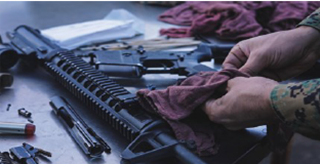 The DoW STED Program conducted test and evaluation (T&E) of biobased CLP for weapons and weapons systems at Department of War (DoW) Installations.
Firearm cleaners, lubricants, and protectants have been designated for Federal procurement preference by the United States Department of Agriculture (USDA) BioPreferred Program. The BioPreferred Program defines firearms cleaner, lubricants, and protectants as
“Products that are designed to care for firearms by cleaning, lubricating, protecting, or any combination thereof. Examples include products that are designed for use in firearms to reduce the friction and wear between the moving parts of a firearm, to keep the weapon clean, and/or to prevent the formation of deposits that could cause the weapon to jam.”
The BioPreferred Program, with input from the U.S. Army Armaments Center, established a minimum biobased content of 32 percent for firearm cleaners, lubricants, and protectants.
Before these biobased products are utilized by the Military Departments and DoW Components, their performance must be proven to meet DoW requirements. The biobased CLP products participating in this demonstration meet the requirements of MIL-PRF-63460G, Cleaner, Lubricant, and Preservative (CLP) for Weapons and Weapons Systems. Demonstrated products must be on the applicable Qualified Products List for MIL-PRF-63460G.
Note: The demonstration began while MIL-PRF-63460F was still in effect, which specified two Types of CLP Products: Type A, Traditional, (i.e., non-biobased) and Type B, Biobased. Demonstrated products at that time were on the applicable Qualified Products List for MIL-PRF-63460F under Type B. In November 2023, the U.S. Army Armaments Center issued Revision G of the specification, requiring all qualified products to contain a minimum 33 percent biobased content.
Demonstration Products*
The following biobased products were tested and evaluated:
For more information regarding the biobased CLP demonstration, please Contact Us.

Related Articles
DOD Tests and Evaluates Improved and Sustainable Technologies
By David Vergun, DOD News, 3 October 2024. This article provides additional information regarding the DoW STED Program, to include the biobased CLP demonstration.
A Green Tech Easy Button
By David Asiello, Army AL&T Magazine, Spring 2024. Authored by the STED Program, this article provides additional information, to include the biobased CLP demonstration.
Related Videos
Marines Field Test New Bio-Based CLP Cleaner
By Matthew Hilborn, Defense.gov, 26 Sept. 2024. Video of Marine Corps Shooting Team testing and evaluating biobased CLP.

- G96 Synthetic Bio-CLP by G96 Products Inc
- NYCOLUBE 127 CLP Bio by NYCO
- Spartamax Bio CLP by Spartamax Defense
- Radcolube Biobased CLP by Radco Industries
*Mention of or referral to commercial products, services, and manufacturers herein is provided for informational purposes only and does not constitute endorsement by, nor the official policy or position of, the Department of War (DoW), any of its Components, or the U.S. Government.
Demonstration Sites
Field T&E of biobased CLP products was performed at the following DoW installations and co-located federal facilities to evaluate their performance in Military operational environments and to raise awareness of biobased product availability:
- Fort Benning
- DHS ICE Office of Training and Tactical Programs (OTTP) Firearms and Tactics Division – Fort Benning
- Fort Jackson
- Anniston Army Depot (ANAD)
- Joint Base Lewis-McChord (JBLM)
- Edwards Air Force Base
- Marine Corps Base Quantico
- Marine Corps Base Camp Pendleton
- National Aeronautics and Space Administration (NASA) White Sands Test Facility
- NASA Armstrong Flight Research Center
- Fort Irwin
- Naval Surface Warfare Center Crane
- Naval Special Warfare, Camp Billy Machen
- Naval Special Warfare, Camp Atterbury
- Joint Expeditionary Base Little Creek-Fort Story
- Marine Corps Recruiting Depot Parris Island
- Robinson Maneuver Training Center (U.S. Army National Guard Marksmanship Training Center)
Demonstration Details
A biobased CLP demonstration plan was developed to outline the T&E activities to be performed, identify site performance requirements and the key performance criteria, as well as select the products to be evaluated. Military and civilian personnel at DoW installations and Federal agencies were provided with a supply of the products for the T&E period and asked to provide feedback on the product performance. Table 1 contains the key performance criteria that the stakeholders established to evaluate and validate that the biobased CLP product met the participants’ requirements.
Table 1: T&E Performance Criteria
| Criteria | Parameters |
|---|---|
| Cleaning Efficiency |
|
| Weapon Performance |
|
| Wear Prevention |
|
| Corrosion Prevention |
|
| Ease of Use |
|
T&E Results
Feedback and results from participating demonstration sites indicate that the biobased CLP product met or exceeded the identified key performance criteria as follows:
- The biobased CLP products showed a substantial reduction in weapon cleaning time compared to the baseline non-biobased CLP products. All demonstration sites that provided feedback reported that weapon cleaning time was reduced. An average 50% decrease per site was reported.
- The level of carbon/firing residue buildup during weapon use after the application of the biobased CLP was comparable or less than with the baseline non-biobased CLP products. In most applications, the buildup of carbon/firing residue was reduced.
- The quantity of biobased CLP used during application was substantially less than with the baseline CLP products. An average 52.5% less CLP used per application was reported.
- The quantity of expendable cleaning materials used during a cleaning application with the biobased CLP was comparable or less than with the baseline CLP products. Most demonstration sites reported that the quantity of expendable cleaning materials was reduced.
- Weapon performance using the biobased CLP was comparable or better than with the baseline CLP. All demonstration sites that provided feedback, except one, reported that that weapon performance was better when using the biobased CLP.
- Weapon component wear using the biobased CLP was comparable to the baseline CLP. There were no reported issues with weapon component wear using the biobased CLP.
- Corrosion of weapon components using the biobased CLP was comparable to the baseline CLP. There were no reported issues with weapon component corrosion using the biobased CLP.
- The biobased CLP ease of use was comparable or better than the baseline CLP. There were no reported issues with biobased CLP ease of use. Common feedback relating to better ease of use included less odor, less skin and eye irritation, and less smoke from weapon use.
- A cost analysis determined the biobased CLP products are more cost effective due to their increased cleaning and lubricating effectiveness, which results in less product being needed and used for cleaning and lubrication.
At the request of the U.S. Army Armaments Center, the Defense Logistics Agency (DLA) established the following National Stock Numbers (NSNs) for biobased CLP products on the Qualified Products List (QPL):
Demonstration Product National Stock Numbers
NSN / Container Size
9150-01-663-4635 / 0.5 ounce bottle
9150-01-663-3879 / 4 ounce bottle
9150-01-663-4643 / 1 pint bottle with sprayer
9150-01-663-4623 / 1 liter bottle with sprayer
9150-01-663-4610 / 1 gallon bottle
The STED Program will coordinate with the Military Services to verify applicable technical documents (e.g., technical manuals and technical orders) have been updated to reference the National Stock Numbers for qualified products.