
Demonstration Overview
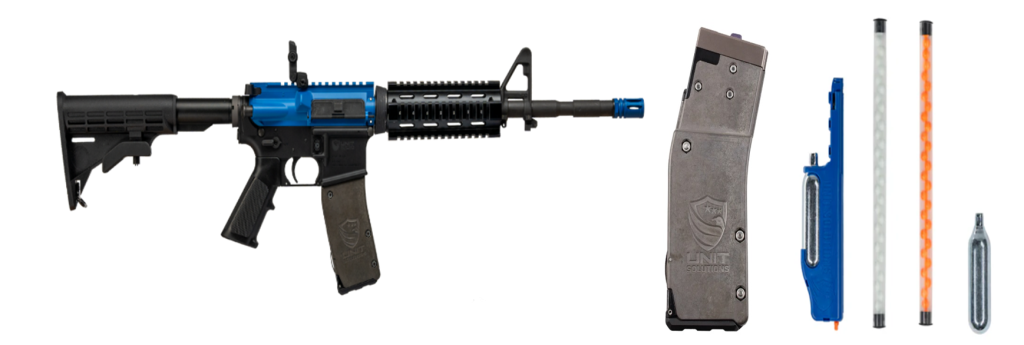
The DoW STED Program is conducting test and evaluation (T&E) of non-lethal training firearms that utilize carbon dioxide (CO2) propelled non-lethal soft training rounds at Department of War (DoW) Installations. Such firearms offer a safe, reusable, and adaptable solution for close-quarter, urban, and force-on-force scenarios while significantly reducing training costs, range and ammunition usage, logistical demands, and injury risk.
Demonstration Products*
For more information regarding the non-lethal simulated training firearms demonstration, please Contact Us.


The following systems were selected for test and evaluation:
- Unit4 Training Rifle by Unit Solutions
- Unit4 Magazine by Unit Solutions
- TPAK by Unit Solutions
*Mention of or referral to commercial products, services, and manufacturers herein is provided for informational purposes only and does not constitute endorsement by, nor the official policy or position of, the Department of War (DoW), any of its Components, or the U.S. Government.
Demonstration Sites
Field T&E of these products occurred or is occurring at the following DoW installations to evaluate their performance in operational environments and to raise awareness of product availability:
- MCB Quantico, Weapons Training Battalion
- MCB Hawaii, 3rd Marine Littoral Regiment
- Fort Benning, DHS ICE Office of Firearms and Tactical Programs (OFTP)
Demonstration Details
The simulated training firearms replicate the size, weight, and handling characteristics of standard-issue weapons, with training rounds and a CO2 cartridge loaded in the magazine. They use non-toxic, biodegradable soft projectiles—both marking and non-marking—and provide a reusable, scalable solution for various training scenarios. The firearms offer a supplemental alternative to live-fire for many training applications and support off-range training, reduce logistics burdens (e.g., range scheduling, travel time, and range set up and cleanup), and minimize health and safety risks (e.g., low noise levels (85 decibels), no combustion byproducts or firing residue, and no lead exposure). While not intended to replace all aspects of live-fire training, they offer significant potential to expand training flexibility, increase warfighter proficiency, and raise unit readiness. Prior to implementation, these training firearms must be demonstrated to validate their operational effectiveness, safety, and suitability across a range of training environments and use cases.